Redemption or déjà vu all over again?
Montreal gets another shot at the Grey Cup. Edmonton stands in the way.
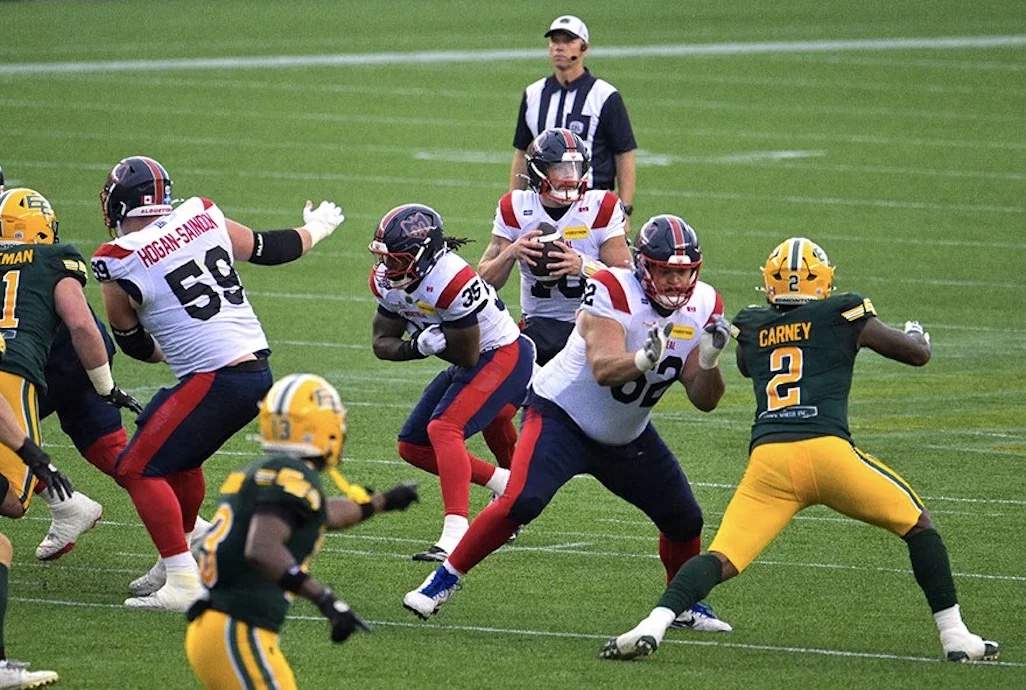
A year ago, Montreal lost the Grey Cup 25-17 to Saskatchewan. On Sunday in Calgary it gets another shot, this time against an Edmonton team that went 7-11 last year with the CFL’s worst defence and now has its best.
Montreal finished 14-4 with the CFL’s best offence. Edmonton finished 13-5 with the league’s best defence, allowing −0.158 EPA per play, far better than any other team. In our power rankings, which use net EPA (offence minus defence, adjusted for opponents), Edmonton is No. 1 and Montreal is No. 2.
The teams split the season series. Edmonton won 32-29 in Week 3, and Montreal won 48-30 in Week 10. These two teams are about as even as it gets, but they win in very different ways, and each has a weakness the other is built to attack.
1. Montreal’s weakness: when the pass game stalls
Montreal had the best passing game in the CFL this year, and when it’s on, Montreal wins. In its 15 wins, Montreal averaged +0.34 EPA per pass.
Montreal’s team depends on its passing game. In all four of its losses this season, and in last year’s Grey Cup, Montreal’s pass EPA was +0.05 or worse, about league average. When its passing was that ordinary, Montreal went 1-4. Edmonton went 8-3.
Montreal’s passing game runs through Alexander and his top two receivers. Tyson Philpot led the league with 1,809 yards, Tyler Snead was 2nd with 1,474, and they tied for the league lead with 13 touchdowns each. In Week 10, they combined for 277 yards and 3 TDs.
If Edmonton can keep Philpot and Snead quiet, the rest of Montreal’s team has to step up, and it hasn’t done that enough this year. Montreal’s special teams were below average in 14 of its 19 games, and in its four losses they cost more than six points a game. In Week 3 against Edmonton, special teams cost Montreal about 7.5 points in a game it lost by three. The defence hasn’t covered for it either: Montreal allowed 35 points a game in its losses, compared with 24 in its wins.
2. Edmonton’s weakness: red zone troubles
Edmonton’s defence has been a wagon all year, and finding a weakness wasn’t easy. It allowed just 2.8 red zone trips a game, the fewest in the CFL, and when it holds teams to three or fewer, Edmonton is 12-1.
When teams get there more than three times, Edmonton tends to lose. In four of its five losses, opponents managed to reach the red zone five times:
- BC in Week 5, a 36-24 loss
- Saskatchewan in Week 9, a 28-26 loss
- Montreal in Week 10, a 48-30 loss
- Toronto in Week 16, a 24-19 loss
The two games against Montreal show this. In Week 3, Montreal reached the red zone just once. Four other drives stalled before the 20 and ended in field goals from 31 to 50 yards, and Edmonton won by three. In Week 10, Montreal got to the red zone five times and came away with four touchdowns. Montreal converted 74% of its 2nd downs that day, up from 54% in Week 3.
Montreal reaches the red zone 3.7 times a game, 2nd in the league, and scores touchdowns on 71% of those trips. Edmonton’s offence gets there more than anyone but scores touchdowns on just 51%, the lowest rate in the league. If Montreal gets inside the 20 four or five times on Sunday, Edmonton’s defence will need to hold up in a way it hasn’t all season.
3. Montreal’s edge: Edmonton hasn’t solved it
Edmonton’s defence is at its best on 2nd down. It forced more failed 2nd downs than any team in the league and allowed just 47% conversions. That’s also where Montreal’s offence is strongest, and in two meetings Edmonton hasn’t found an answer.
Montreal gave up a sack on just 3% of its dropbacks this season, the lowest rate in the CFL. Edmonton ranks 3rd in sack rate, but in two games against Montreal it didn’t sack Alexander once.
Montreal is also the best team in the league on 2nd & long. On 2nd & 7 or more, most CFL teams convert about 36% of the time. Montreal converted 46%, and no one else was near them. Even against the best 2nd-down defence in the CFL, Montreal went 11 of 24 (46%) on 2nd & long in the two meetings.
Alexander is also playing well right now. His +0.315 EPA per dropback in the East Final was the best of any QB in the Division Finals. If Edmonton wants to slow down Montreal’s passing game, it has to get to Alexander. In two games, it hasn’t sacked him once.
4. Edmonton’s edge: the run game and big plays
Big plays are passes of 20+ yards and runs of 10+, and they go a long way toward deciding games. This season, the team with more big plays won 71% of CFL games. Here’s how often the team that came out ahead in each stat also won the game:
- EPA per play: 84%
- Big plays: 71%
- Success rate: 71%
- Turnover margin: 70%
- 2nd-down conversion: 69%
For these two teams it’s been even more important. Both are 11-1 this season when they have more big plays, and both meetings went to the team that did.
Edmonton gets most of its big plays on the ground, and its run game is a three-headed monster.
Justin Rankin led the CFL with 47 big plays in the regular season, but he’s boom or bust. He was stopped at or behind the line on 23% of his carries, the highest rate of any back with 100+ carries. Since Week 14 he’s shared the load with ShunDerrick Powell, who has been the more efficient back. Powell averages 6.7 yards a carry, is tied for the league’s highest big-run rate at 21%, and got more carries than Rankin in the West Final.
Cody Fajardo is the third head. He ran 97 times this season, nearly double any other QB, for 614 yards. He’s been quiet against Montreal, with 57 yards on 9 runs in the two meetings, but he’s coming off 84 yards in the West Final.
Montreal’s defence is one of the best in the league at stopping big passes but one of the worst at stopping big runs. It ranks 6th against backs and allowed 7.5 yards per QB run, the most in the league. Teams that run well on Montreal tend to beat it: Montreal allowed 125+ rush yards in three of its five losses, and only twice in 15 wins. That’s what happened in Week 3, when Edmonton ran for 178 yards and Rankin broke free for big touchdown runs.
Big plays are also how Montreal lost last year’s Grey Cup, when Saskatchewan had 11 to Montreal’s 8. If Montreal wants to win this time, it has to win the big-play battle, and that starts with stopping Edmonton’s run game. If it can’t, it’s déjà vu all over again.
EPA, win probability and team stats come from the same models as the rest of the site. How they work · Team stats · Player stats